
Total Quality Management (TQM)


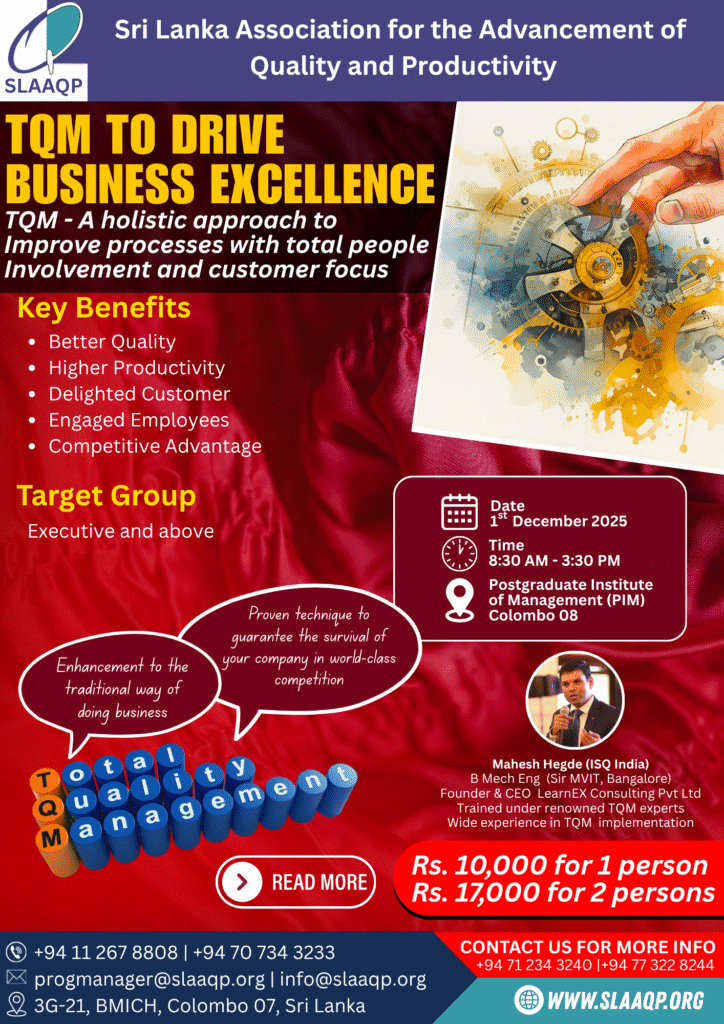
TQM TO DRIVE BUSINESS EXCELLENCE
Program Details
- Date: 01st December 2025
- Time: 8:30 a.m. – 3:30 p.m.
- Venue: Postgraduate Institute of Management (PIM)
Total Quality Management (TQM)
Total Quality Management (TQM) is a comprehensive management philosophy focused on achieving long-term success by satisfying customers through continuous improvement of all organizational processes. It involves every employee, from top management to frontline workers, in maintaining and improving quality standards across products, services, and systems. TQM emphasizes that quality is not only the responsibility of a specific department but a collective commitment throughout the organization.
The concept of TQM originated in the 1950s and gained global prominence in the 1980s through the work of quality pioneers such as W. Edwards Deming, Joseph Juran, and Kaoru Ishikawa. They emphasized the importance of customer satisfaction, employee involvement, and process improvement. Deming’s 14 principles and Juran’s quality trilogy became the foundation of modern quality management systems used worldwide.
TQM operates on several key principles: customer focus, continuous improvement (Kaizen), teamwork, employee empowerment, data-driven decision-making, and strong leadership commitment. The goal is to prevent defects rather than detect them, thereby reducing waste and increasing efficiency. Tools such as 5S, quality circles, cause-and-effect diagrams, Pareto analysis, and statistical process control (SPC) are often applied to achieve these objectives.
Successful implementation of TQM brings numerous benefits, including improved product quality, higher customer satisfaction, reduced costs, and increased employee morale. It also fosters a culture of transparency and accountability, where everyone strives for excellence. Many global companies—such as Toyota, Sony, and Motorola—have used TQM principles to gain a competitive advantage and achieve world-class performance.
In summary, Total Quality Management is more than a technique; it is a culture and mindset. By embedding quality into every process and decision, organizations can achieve sustainable growth, customer loyalty, and continuous innovation in an increasingly competitive environment.
1. What is TQM
Total Quality Management (TQM) is a comprehensive and structured approach to improving the quality of products, services, and processes across an organization. It is based on the principle that every employee—from top management to front-line workers—is responsible for maintaining high standards of quality. TQM focuses on continuous improvement (Kaizen), customer satisfaction, and teamwork. It seeks to prevent problems rather than fix them, ensuring that quality becomes part of the organizational culture.
The philosophy of TQM was developed and popularized by quality pioneers such as W. Edwards Deming, Joseph Juran, and Kaoru Ishikawa. Their work emphasized leadership commitment, employee involvement, process control, and customer focus. TQM integrates tools like 5S, Quality Circles, Statistical Process Control (SPC), and root cause analysis to identify and eliminate waste, defects, and inefficiencies.
2. Importance of TQM to Sri Lanka
For Sri Lanka, adopting TQM is essential to compete in both local and global markets. As the country moves toward industrialization and exports, maintaining high-quality standards has become a national priority. TQM helps Sri Lankan companies meet international certifications such as ISO 9001 and enhances reputation among global buyers.
Furthermore, TQM improves productivity and reduces costs—two critical factors in strengthening Sri Lanka’s economic competitiveness. The government and professional organizations such as SLAAQP (Sri Lanka Association for the Advancement of Quality and Productivity) play a key role in promoting TQM awareness and training across industries. By embedding quality in all sectors, Sri Lanka can achieve sustainable growth, attract foreign investment, and create a culture of excellence.
3. Benefits of TQM to the Engineering Industry
In the engineering sector, TQM ensures that every stage—from design to maintenance—meets strict quality requirements. It helps reduce errors, rework, and equipment downtime. Engineers using TQM principles rely on data-driven decisions, preventive maintenance, and process standardization, leading to safer, more reliable, and cost-effective products. Continuous improvement in engineering processes results in higher customer satisfaction and increased competitiveness in global projects.
4. Benefits of TQM to the Garment Industry
The garment industry is one of Sri Lanka’s largest export earners. TQM enables manufacturers to maintain consistent quality, meet tight delivery schedules, and satisfy demanding international buyers. By applying tools like 5S and Kaizen, factories can improve efficiency, minimize fabric waste, and boost worker morale. TQM also strengthens teamwork and communication between production lines, helping Sri Lanka maintain its reputation for quality apparel in markets like the USA and Europe.
5. Benefits of TQM to the Service Sector
In the service sector—such as hotels, hospitals, banks, and education—TQM improves customer satisfaction, reliability, and responsiveness. Service quality depends largely on human interaction, so TQM emphasizes staff training, feedback systems, and continuous service improvement. This results in happier customers, loyal clients, and stronger organizational performance.
6. Benefits of TQM to the Public Sector
In the public sector, improving efficiency and effectiveness, which leads to increased citizen satisfaction, reduced waste, and better use of public funds. Other advantages include enhanced competitiveness, greater adaptability to change, improved employee morale, and a stronger reputation through better service delivery. TQM emphasizes using data to identify problems and measure progress, which results in more informed and objective decisions.
Conclusion
Total Quality Management (TQM) adoption across all sectors – engineering, garments, public sector and services in Sri Lanka would boost productivity, gain global recognition, and support sustainable national development by enhancing quality, satisfying customers, and improving processes. By focusing on customer satisfaction, process efficiency, and employee involvement, TQM can improve competitiveness and overall performance for organizations in Sri Lanka,
Total Quality Management (TQM) adoption across all sectors – engineering, garments, public sector and services in Sri Lanka would boost productivity, gain global recognition, and support sustainable national development by enhancing quality, satisfying customers, and improving processes. By focusing on customer satisfaction, process efficiency, and employee involvement, TQM can improve competitiveness and overall performance for organizations in Sri Lanka,

Hemantha Weerakoon, PhD Hon.
Secretary, SLAAQP
Program Details:
Program Price:
Rs. 10,000 for Person / Rs. 17,000 for 02 Persons
Instructor
Mahesh Hegde (ISQ India)
Lesson Duration
07 Hours
Lessons
01
Location
Postgraduate Institute of Management (PIM) Colombo 08
Language:
English
Certifications
Digital, Physical
Importance of Total Quality Management (TQM)
Introduction
TQM is a management approach that originated in the 1950s and has steadily grown to reach world-wide popularity in the 1980s. Total Quality portrays of the culture, attitude and organization of a company that strives to provide products and services that satisfy the customer’s needs. The culture requires quality in all aspects of the company’s operations, with processes to deliver right first time and defect free while eradicating waste from all operations
In other words, TQM is the continuous process of eliminating errors in manufacturing, streamlining the supply chain, improving the customer experience, and ensuring that employees are up to the required level with their training.
TQM efforts draw heavily on the previously developed tools and techniques of quality control. Total quality management consists of organization-wide efforts to “install and make a permanent climate where employees continuously improve their ability to provide on demand products and services that customers will find of particular value.” “Total” emphasizes that departments in addition to production are obligated to improve their operations; “management” emphasizes that executives are obligated to actively manage quality through funding, training, staffing, and goal setting.
TQM Awards
TQM also led to the Deming Prize that commenced in Japan in 1951. The Prestigious Deming Prize in Japan is named after Dr. W. Edwards Deming, an American statistician and quality management pioneer who influenced Japan’s post-war industrial reconstruction to honour his contributions and encourage companies to adopt and excel at quality management practices. This prize was created and administered by the Japanese Union of Scientists and Engineers (JUSE).
On similar lines of process excellence, the Malcolm Baldridge National Quality Award (MBNQA) commenced in the US in 1988 managed by the National Institute of Standards and Technology (NIST). The European Quality Award now referred to as the EFQM(European Foundation for Quality Management) Excellence Award that commenced in 1992 was developed with a key objective of creating a European Quality Award following the example of the American Malcolm Baldridge National Quality Award. Consequently, a few other countries developed their own national quality awards.
The SLAAQP has developed a TQM Excellence Award. The guidelines for this SLAAQP TQM Excellence Award are structured using the stringent criteria of the internationally renowned Deming Prize administered by the Union of Japanese Scientists and Engineers (JUSE). This award will be used as a precursor for Sri Lankan companies to apply for the prestigious Deming award in the future.
TQM and ISO
TQM was developed as a formal concept during the 1980s and 1990s in the West, as a response to the success of Japanese manufacturing companies. However, its foundational ideas were established much earlier, with roots tracing back to the mid 20th century. TQM enjoyed widespread attention during before being dominated by ISO 9000, Lean manufacturing, and Six Sigma.
ISO is the International Organisation for Standardisation which is an independent non-governmental organisation with its general secretariat in Geneva, Switzerland. ISO has 167 countries as members. The members are national standards bodies from each country, and they work together to develop and promote international standards. ISO 9000 family of standards was first published in 1987 as the first quality management standard and was based on the British Standard BS 5750 first published in 1979.
ISO 9000 is a standard for quality assurance, focusing on documented processes to ensure products and services consistently meet customer requirements, while TQM is a broader philosophy for continuous, organization-wide improvement that includes quality management. ISO 9000 can be a stepping stone toward TQM because its structured approach to quality systems creates a foundation for the team-based, employee-driven, and customer-focused principles of TQM.
TQM Definitions
TQM has many definitions. But they all emphasize on continuous improvement, involving all employees in achieving quality excellence. TQM is a management philosophy that seeks to integrate all organizational functions i.e. design, marketing, finance, production/manufacturing, engineering and maintenance, distribution to retail and also customer service The focus is on meeting customer needs while following the organizational objectives. It fosters a culture of in-built quality, teamwork, proactive and practical problem-solving, and a commitment to excellence, with an effort to eliminate defects, reduce waste, and enhance overall performance of an organisation.
TQM places much attention on the processes of an organisation. The philosophy emphasises that organizations must strive to continuously improve these processes by incorporating the knowledge and experiences of workers.
The simple objective of TQM is “Do the right things, right the first time, every time.” TQM is infinitely variable and adaptable. Originally it was applied only to manufacturing operations, but now is becoming recognized as a generic management tool, applicable in the service sector as well as in the public sector organizations.
Foundation of TQM
TQM is the foundation for activities, which include:
Commitment by senior management and all employees, Meeting customer requirements, reducing development cycle times, Just in time/demand flow manufacturing, Improvement teams, reducing product and service costs, Systems to facilitate improvement, Line management ownership, Employee involvement and empowerment, Recognition and celebration, Challenging quantified goals and benchmarking, Focus on processes / improvement plans¸ Specific incorporation in strategic planning
This indicates that TQM must be practiced in all activities, by all personnel, in planning, designing, manufacturing, marketing, engineering, R&D, sales, purchasing, HR, etc. For this reason, all employees must be aware of the principles of TQM.
Principles of TQM
The key principles of TQM are:
- Management Commitment
- Employee Empowerment including training for excellence
- Fact Based Decision Making using SPC, 7 tools, DOE, FMEA, Ford 8D – TOPS
- Continuous Improvement with systematic measurement and Excellence teams with cross-functional process management to attain, maintain and improve standards
- Customer Focus never compromising quality and towards Customer driven standards
Teachings and readings
There is no single theoretical formalization of total quality, but Deming, Juran, Ishikawa and Feiganbaum provide the core assumptions, as a “discipline and philosophy of management which institutionalizes planned and continuous improvement and assumes that quality is the outcome of all activities that take place within an organization; all functions and all employees participating in the improvement process;
TQM is a journey and not a destination. Organisations should first assess the preconditions and the current state of the organization to make sure the need for change is clear and that TQM is a suitable strategy. Leadership styles and organizational culture must be consistent and matching with TQM. If they do not, management must start working on this or else TQM implementation should be delayed until favourable conditions exist.
TQM should be purpose driven. A clear vision for the future of the organization. Very important to stay focused on it. TQM can be a powerful technique for unleashing employee creativity and potential, reducing bureaucracy and costs, and improving service to clients and the community. TQM could be the solution to increased sales and market share.
Conclusion
TQM implementation is an uphill task. This will be a difficult, comprehensive, and a long-term process. Leaders will need to maintain their commitment, keep the process visible, provide necessary support, and hold people accountable for results and recognise them.
Research and expert opinions consistently identify TQM and its associated cultural change as crucial for enhancing performance and competitiveness in Sri Lankan organizations, particularly in the service and manufacturing sectors which are vital to the economy.
Instilling Total Quality Management (TQM) principles and working towards a complete culture change is a key element in Sri Lanka’s march towards economic growth.
Total Quality Management (TQM) adoption across all sectors – engineering, garments, public sector and services in Sri Lanka would boost productivity, gain global recognition, and support sustainable national development by enhancing quality, satisfying customers, and improving processes. By focusing on customer satisfaction, process efficiency, and employee involvement, TQM can improve competitiveness and overall performance for organizations in Sri Lanka,

Nirmali de Silva, PhD.
Vice President – Technical, SLAAQP
Program Details:
Program Price:
Rs. 10,000 for Person / Rs. 17,000 for 02 Persons
Instructor
Mahesh Hegde (ISQ India)
Lesson Duration
07 Hours
Lessons
01
Location
Postgraduate Institute of Management (PIM) Colombo 08
Language:
English
Certifications
Digital, Physical

